 Gas Prices Philippines
Why Diesel and Gasoline Prices Move Differently
See how separate refined fuel markets, peso exchange rates, and local conditions affect gasoline and diesel prices in the Philippines.
Published
Independent fan site with no Philippine government affiliation.
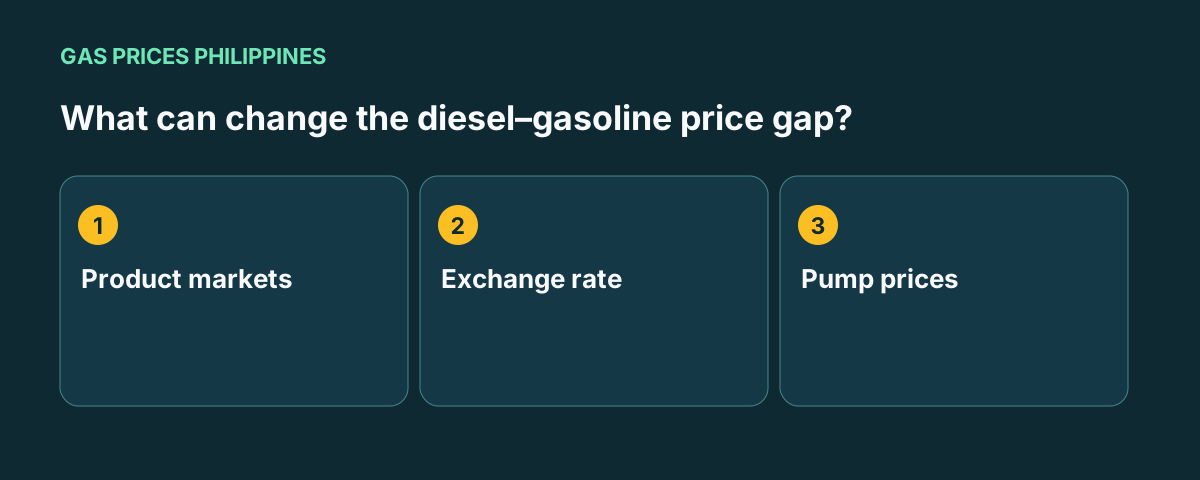
- Product markets. Gasoline and diesel have different buyers and supplies.
- Exchange rate. Dollar-denominated figures must be converted to pesos.
- Pump prices. Match date, grade, and station before measuring the gap.
What to check
- Different gasoline and diesel markets can move by different amounts in the same week.
- Use separate product benchmarks and the peso-dollar conversion when looking at inputs.
- A price gap compares two posted prices. A weekly adjustment compares prices over time.
The same crude market feeds two different product markets
Diesel and gasoline are sold as separate refined products, with different specifications and buyers. Demand for road transport, industry, and other uses can affect the market for one product differently from the market for the other. Regional stock levels, refinery outages, or disruptions in deliveries can also have unequal effects.
That is why a change in crude oil prices alone is insufficient to estimate either fuel’s retail change. Even when crude prices fall, the market price of a particular refined product may remain firm if its supply tightens or demand holds up. Look for a comparable gasoline or diesel benchmark before drawing a conclusion about its direction.
The peso and pump costs also matter
A refined fuel benchmark quoted in U.S. dollars must be converted before it can be compared with a Philippine price in pesos. If the dollar-denominated price stays the same and the peso weakens against the dollar, the same amount costs more pesos. A stronger peso can have the opposite effect. The direction of the peso and the dollar price can therefore reinforce or offset one another.
The final posted price also reflects costs and decisions beyond the benchmark, including delivery, station pricing, and applicable taxes. Compare like with like when interpreting survey ranges. Different dates, stations, fuels, and gasoline grades can make a gap look larger or smaller than it is for the exact products you buy.
Measure the difference at a station
Imagine a station selling a specified gasoline grade at ₱70/L and diesel at ₱79/L. In this illustration, the diesel price is ₱9/L higher. If gasoline later rises by ₱2/L and diesel rises by ₱0.50/L, the gap narrows to ₱7.50/L even though both fuels went up. A difference in adjustment is a change in the gap, not the gap itself.
To track the gap you actually face, write down the station, date, exact gasoline grade, diesel product, and both prices. Subtract the gasoline price from the diesel price for each observation. Read a forecast as an estimate of changes, and use surveys or a station quote when you need posted prices.
Look at the two prices separately as well. A narrowing gap can occur because either fuel became more expensive, because either became cheaper, or because both moved. The gap alone will not tell you whether your next fill costs more.