 Gas Prices Philippines
What Is the Difference Between Diesel and Gasoline?
Learn how gasoline and diesel differ, which pump labels to look for, and how to compare fuel cost per kilometer across compatible vehicles.
Published
Independent fan site with no Philippine government affiliation.
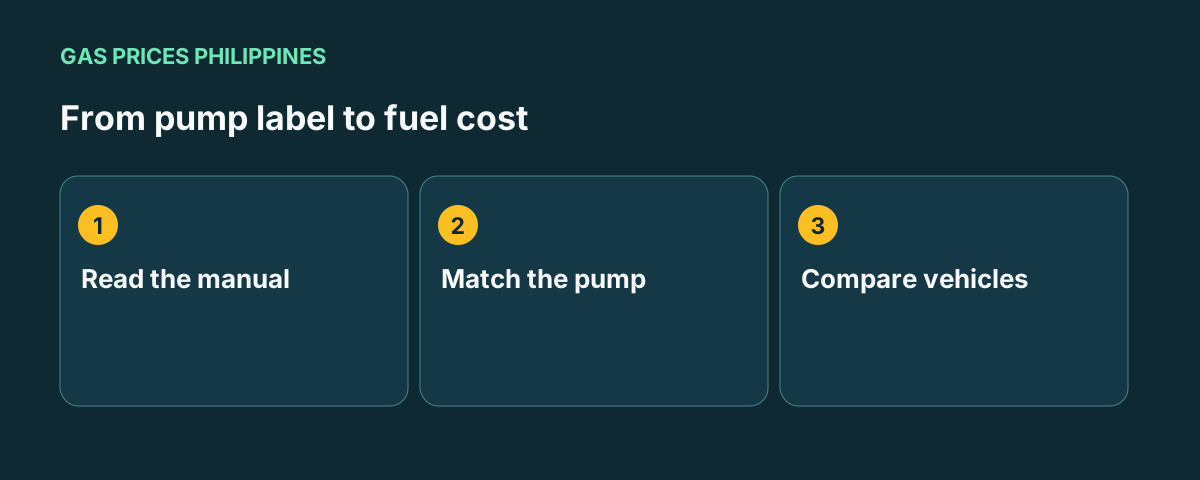
- Read the manual. Confirm the required fuel for the vehicle.
- Match the pump. Choose the correct gasoline grade or diesel.
- Compare vehicles. Use observed fuel use to calculate pesos per kilometer.
What to check
- Use the fuel and grade specified by the vehicle maker.
- Unleaded is a gasoline label. Diesel is listed separately.
- For comparisons across vehicles, divide pesos per liter by kilometers per liter.
The engine determines the fuel
Gasoline and diesel are different products, and your vehicle is designed to use a specified fuel. A conventional gasoline engine uses a spark to ignite its air-fuel mixture. A conventional diesel engine compresses air until it is hot, then injects diesel so it ignites. The fuel is part of the engine’s design, so a lower price for the other product does not make it a substitute.
Check the manual or the fuel-door label when driving an unfamiliar or borrowed vehicle. On Philippine pump boards, gasoline may be labelled by an octane grade such as RON 91 or RON 95. Diesel is listed as a separate product. Ask the attendant for the exact product the vehicle requires, especially when promotions use names that are unfamiliar.
Unleaded is a gasoline label
In everyday station use, unleaded refers to gasoline. Regular or premium names can vary by brand, so use the octane grade shown on the pump and the minimum required by the vehicle maker. A higher-grade gasoline remains gasoline. Diesel does not become an option for a gasoline vehicle because the prices or brand names look similar.
If you suspect the wrong fuel was dispensed, check the owner’s manual and consult the vehicle manufacturer, dealer, or roadside assistance service. Give them the model, fuel dispensed, and approximate quantity if known. The right response depends on the vehicle and circumstances.
For a shared vehicle, tell each driver the required fuel and grade. A receipt showing the pump product, liters, and station gives the driver something concrete to check if there is a question after the purchase.
Compare cost per kilometer for two different vehicles
If you are comparing a gasoline vehicle and a diesel vehicle, use consumption for the two vehicles on similar trips. Divide the pump price in pesos per liter by observed kilometers per liter. For illustration, a vehicle using ₱72/L gasoline at 12 km/L costs ₱6/km in fuel. A different vehicle using ₱84/L diesel at 15 km/L costs ₱5.60/km.
Those figures are made-up inputs for the calculation. They do not show that one engine type always saves money. Traffic, load, driving conditions, and the individual vehicle affect consumption. Fuel cost per kilometer covers only one part of the cost of owning or operating a vehicle.