 Gas Prices Philippines
How crude oil prices affect Philippine pump prices
Follow crude benchmarks, refined fuel prices, and the peso exchange rate to understand why oil news and local pump changes can diverge.
Published
Independent fan site with no Philippine government affiliation.
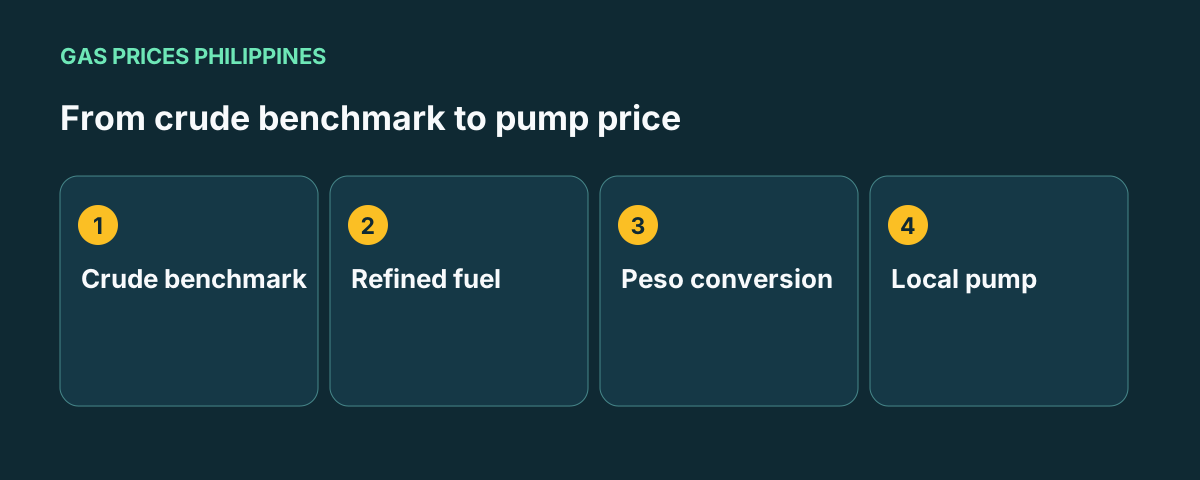
- Crude benchmark. US dollars per barrel of crude
- Refined fuel. Separate gasoline and diesel markets
- Peso conversion. Match the exchange rate to the period
- Local pump. Check retail pesos per litre by grade
What to check
- Separate crude benchmarks, refined-product quotations, and posted pump prices.
- Match dates and currency before comparing two price movements.
- Use the station price for your actual fill-up budget.
Which price is the headline quoting?
Crude oil is the raw material that a refinery processes into products such as gasoline and diesel. Brent and West Texas Intermediate are crude benchmarks, usually quoted in US dollars per barrel. A station in the Philippines posts the retail price of a particular finished fuel in pesos per litre. Those prices describe different goods at different points in the supply chain.
A crude price movement can change the cost of refinery inputs. Prices of finished products also respond to the supply and demand for each fuel. A headline about US crude futures gives useful market context, while a regional gasoline or diesel quotation is closer to the cost of the fuel motorists buy.
How currency changes the picture
To compare the peso value of a dollar quotation, use the exchange rate for the same period. Here is an illustration using round numbers. A finished fuel costing US$90 per barrel at ₱56 per dollar is worth ₱5,040 per barrel. If the quotation stays at US$90 and the exchange rate moves to ₱57, the same barrel is worth ₱5,130.
That ₱90 difference shows the exchange-rate effect before distribution, taxes, and other costs. It is an example of the input conversion only. Use the site’s methodology page to see the market windows and limitations behind its historical forecasts.
What to compare when the headlines disagree
First, read the label, currency, unit, and date. A daily crude move and a weekly pump adjustment can cover different dates. Next, look for a quotation or notice for your fuel grade. Diesel and gasoline can move in different directions, especially when one product faces a supply constraint or a shift in demand.
Finally, compare a company adjustment with the matching station’s price. A notice of a peso-per-litre change gives you a difference from the previous price. The pump board gives you the amount you would actually pay. When planning a fill, confirm the grade, location, and posted price with that station.
A practical way to check a claim about prices is to write down three source labels before looking at the numbers. Include the benchmark named in the headline, the fuel named in the company notice, and the product on the pump board. Those labels tell you whether you can compare the three figures directly.